
Pulsar is a brand that really flies under the radar. And that’s perfectly understandable today - they’re a sub-brand of Seiko, and not really a cool one like Credor or GS. That’s a shame though, because Pulsar really has an interesting history. That of an American-born brand, lost in Japan.
The Hamilton Pulsar was the world’s first LED watch, introduced to the watch market on May 6th, 1970¹ on the Tonight Show with Johnny Carson, who actually mocked the Pulsar prototype on air. People often forget this invention as the focus was on quartz in the early 1970s, but LED was here to stay. The Pulsar was actually made by two companies, Hamilton and Electro/Data, Inc. A man named George H. Thiess was at the head of Electro/Data, the founder of the company, which was based in Garland, Texas and already looking at the issue of LED watches. Engineers at Hamilton would’ve also been studying the same issue, with John Bergey leading the research, who had previously working on military watches. The idea of making a digital watch is said to have come from Stanley Kubrick, who contacted Hamilton to make one for his 2001: A Space Odyssey. Bergey would’ve set to work on this endeavor, who supposedly held 26 patents for different aspects of the watches. He became President of the newly formed Time Computer Inc. – a joint venture between Hamilton and Electro/Data, Inc. for the production of the Pulsar. The name Pulsar interestingly comes from the Pulsar in astronomy which refers to a highly magnetized star that emits radiation. These had only recently been discovered, first observed by Jocelyn Bell Burnell and Anthony Hewish in 1967. The first Pulsar watch, although introduced as a concept in 1970, was only released in 1972!

Hamilton Pulsar P1 in 18k gold / Credit: Revolution Watch
It was originally marketed as ‘space age’ technology, which makes sense as Time Computer, Inc. was also responsible for the production of the first pulse reading and calculator watches.
While the Pulsar was extremely popular at first, the price was extraordinary, retailing for $2,100! The Hamilton Pulsar at the time came in 18k gold (or eventually steel which cost $275) and used 4000 bonding wires and 44 integrated chips, Electro Data, Inc. had made early prototypes of the display and is supposed to have contacted Hamilton. The quartz oscillated at 32,768 Hz, which is the same as the Grand Seiko 9R Spring Drive movement today! Perhaps that’s why they bought the company?
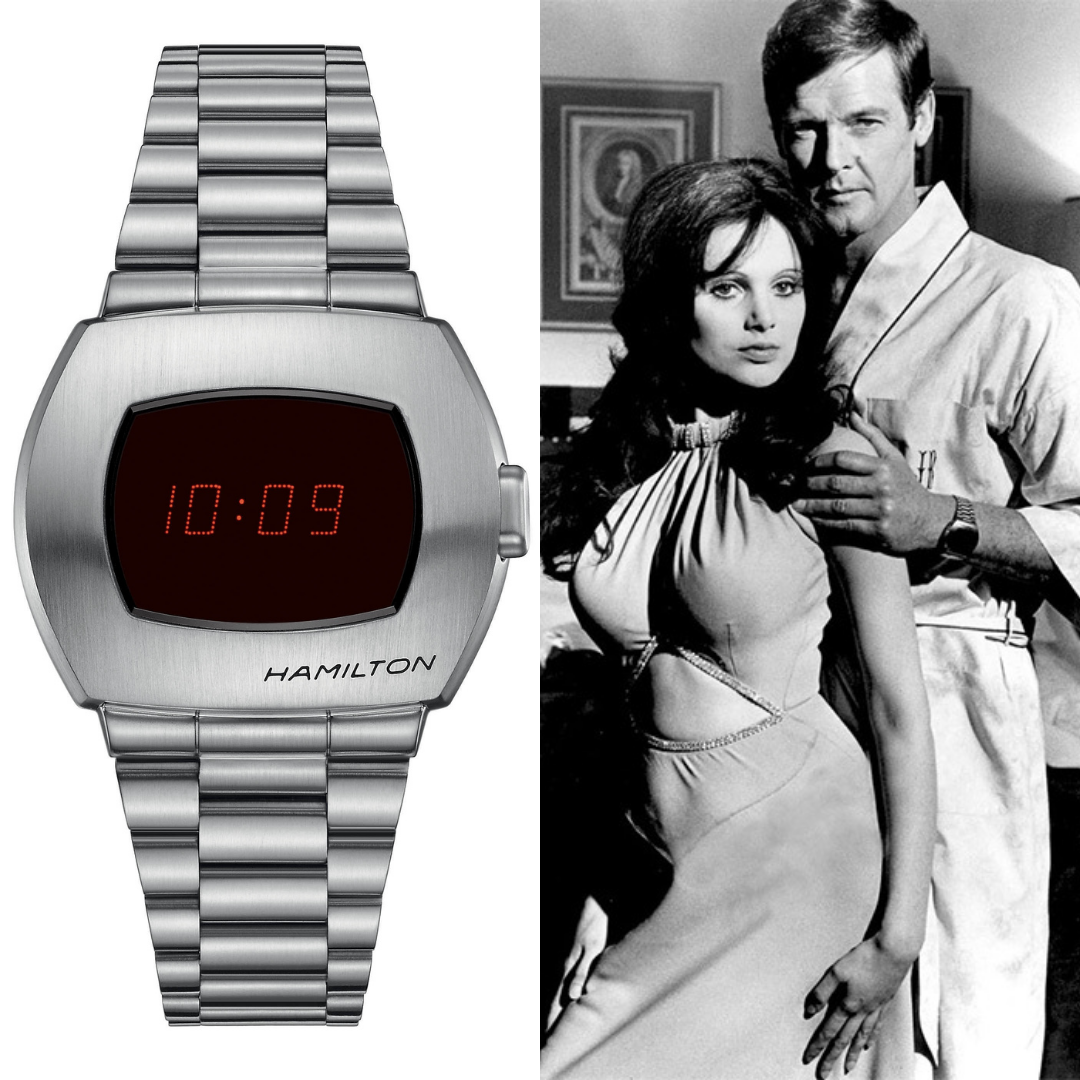
The Hamilton Pulsar was also quite a bit of a pop culture phenomenon in its heyday, mostly for its ‘space age’ look. It was featured prominently in many films like 1973’s James Bond Live and Let Die, which featured Roger Moore as Bond. That film featured a Hamilton Pulsar P2 2900. It was also worn by many famous people at the time like Elvis, Elton John, and Jack Nicholson.
This was all great news for Hamilton, that was losing money before the launch of this watch and feeling pressure due to the Quartz Attack.

Pulsar Calculator Watch / Credit: Smithsonian
Unfortunately for Hamilton, however, two things really killed off the Pulsar. On one hand LED technology was superseded as LCD technology proved more practical, and on the other Texas Instruments started mass-producing LED watches in the mid-1970s – significantly impacting the market for branded ‘luxury’ LED watches like the Hamilton Pulsar.
Ultimately, Hamilton divested from the Time Computer, Inc. subsidiary, which was eventually sold to Rhapsody Inc., which then sold the brand to Seiko. Seiko continues to produce Pulsar watches today, although they are vastly different from the maverick and eccentric watch the brand was originally known for.
By: Andres Ibarguen
Read more:
“Pulsar Electronic Watch Introduced by Hamilton.” New York Times, May 7th, 1970, https://www.nytimes.com/1970/05/07/archives/pulsar-electronic-watch-introduced-by-hamilton.html.
Zhang, Klaus. “The Pulsar: A Revolution in Display Technology.” Pennsylvania Center for the Book, 2010, https://pabook.libraries.psu.edu/literary-cultural-heritage-map-pa/feature-articles/pulsar-revolution-display-technology.
“John Bergey.” The Smithsonian, November 10th, 2010, https://web.archive.org/web/20101110182653/http://invention.smithsonian.org//centerpieces/Quartz/inventors/bergey.html.
Hewish, A. & Bell, S. & Pilkington, J. “Observation of a Rapidly Pulsating Radio Source.” Nature, 217, 709–713, 1968, https://doi.org/10.1038/217709a0.
“Pulsar.” The Smithsonian, March 23rd, 2011, https://web.archive.org/web/20110323064128/http://invention.smithsonian.org/centerpieces/quartz/coolwatches/pulsar.html.