
The Unsung Vintage Hero, the Enicar Super Jet

Enicar Super Jet Sherpa 600, circa 1964
Enicar is known for its Super Compressors and numerous lines of intriguing tool watches. But many forget that Enicar produced several well-regarded pilot watches in the mid-20th century and even rivaled Rolex in their quest to dominate the skies. One of those remarkable watches was the Super Jet, which was also an iconic Super Compressors of the 20th century, easily recognized by its black and white inner bezel.
The Enicar Super Jet was released in 1964 and meant to be a larger version of the Enicar Jet. It was 40mm in diameter, which was quite large for a time when most wristwatches were 34-36mm. The first version was the Mark I and used an Enicar Caliber AR166. The AR166 was self-winding, had a 45-hour power reserve, and 21,600 bph. AR stood for ‘Ariste Racine’, indicating that the movement was manufactured in-house. The Mark II Super Jet was a transition model. It had rounded baton hands, a rally-style GMT hand, and all of the Super Jets had Ervin Piquerez-made Super Compressor cases. The Mark II, however, also had a Sherpa 600 caseback. The Enicar Super Jet line included the Mark III Super Jet but also the Super Jet 33 Mark I and the Super Jet 33 Mark II. It was originally released in the 1960s to compete directly with the Rolex GMT, as there was a big pickup in air travel at the time and pilots needed reliable timepieces. The Enicar Super Jet was used by several airlines including SAS, who also used the Rolex GMT and the Polerouter.
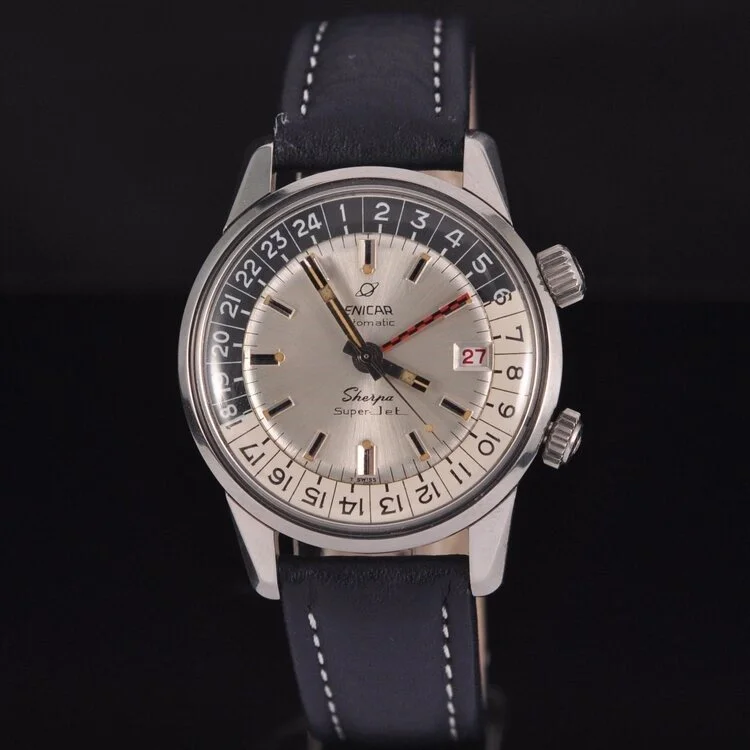
Enicar Super Jet Mark II / Credit: Romain Rea
Ultimately, the Super Jet can be seen as a testament to Enicar’s versatility; a company that made mountaineering watches, dive watches, pilot watches, and more. All of which are still highly desirable today. It did all of this and even used in-house movements, while companies like Rolex and Patek Philippe were still using third-party movements.
By: Eric Mulder