
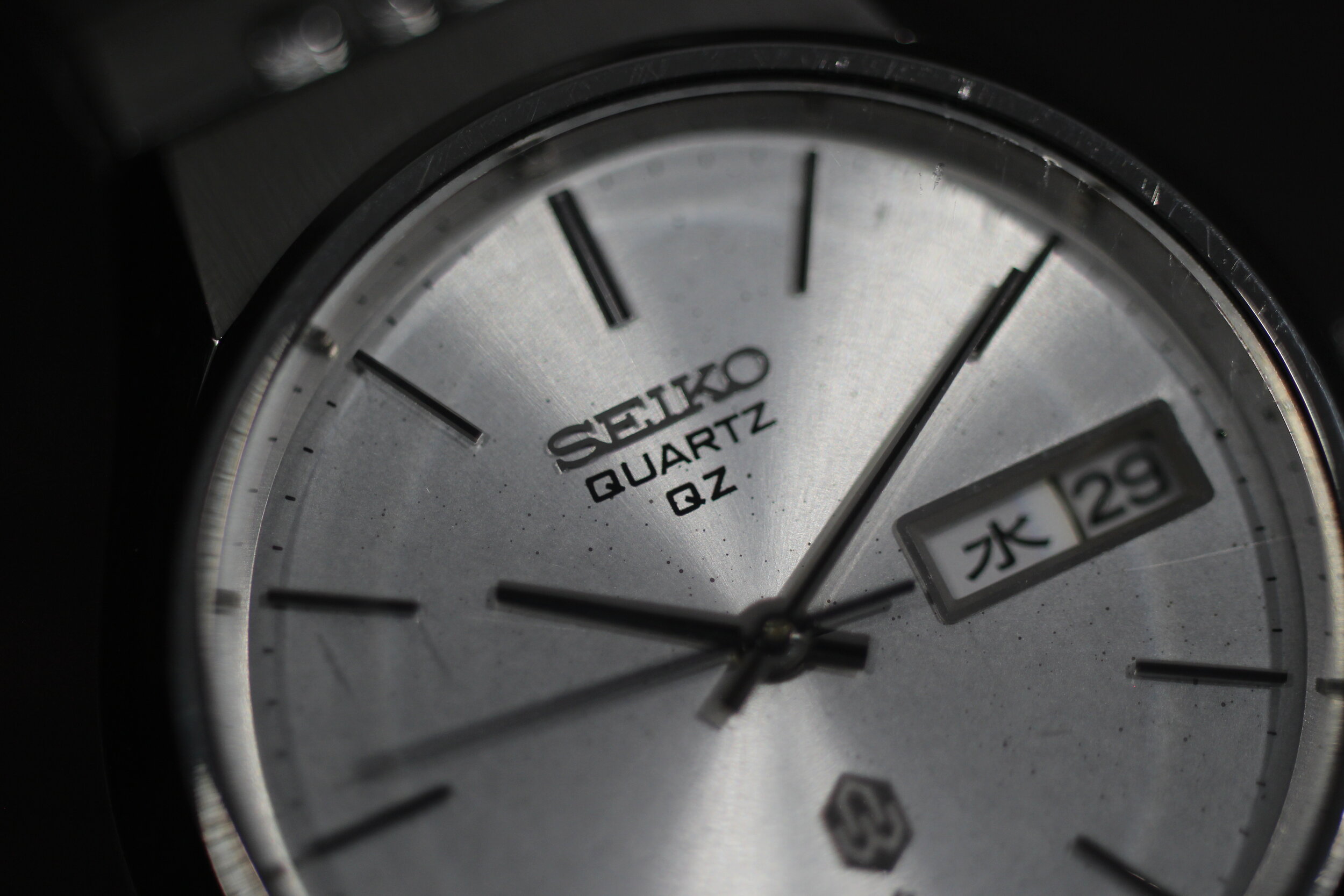
Seiko quartz is definitely on my mind these days. Specifically, my interests lie in 1970s vintage Seiko, the golden days of Seiko quartz. While the first Seiko movement was the 35SQ, in the early 1970s Seiko produced three other lines of Seiko quartz watches: the QT, QR, and QZ. This was the hierarchy of their early quartz movements, with SQ at the top.
The 38SQ and 39SQ were once the highest end Seiko quartz movements, before the release of the Superior line in 1974 with the 3883 movement. These earlier watches were often marked VFA, like the 3823 and had accuracies of +/- 5 seconds per month (SQ) in contrast to the lesser models with accuracies of +/- 15 or 20 seconds (15 for 38QT and 20 for 38QR). The 3823-7000, for example, would’ve been positioned right at the top of the catalogue at a cost of 141,000 Yen. Now, that’s not to say that the QT, QR, or QZ were any less expensive – all quartz was expensive at the time, and these models actually had comparable build and higher prices than the Grand Seiko and King Seiko of the day.
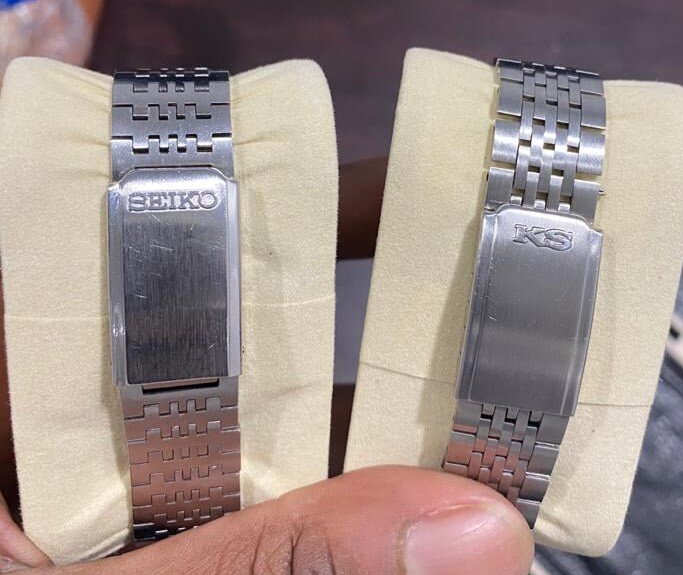
A comparison between the build of my QZ Quartz and a King Seiko Hi-Beat 5626.
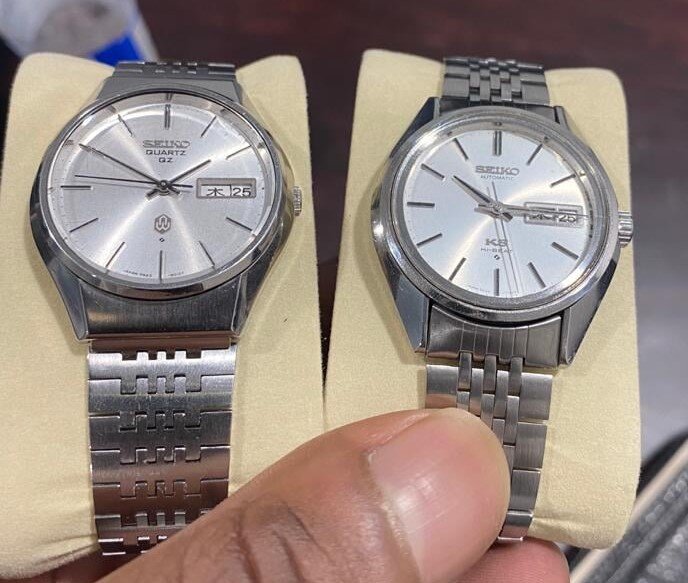
The King Seiko Hi-Beat is available for sale here.
The QT models were still part of the 3800 series that includes the eventual 3883, these were the 38QT movements (3803). These and the QR (38QR) were positioned above, and cost more than, most Grand Seiko models at the time (this pertains more to the QT and doesn’t include the Grand Seiko VFA). Today their cost is not nearly comparable. Only after Grand and King Seiko would you get to the QZ Quartz models. While the SQ line goes back to the late 1960s and the release of the Astron in 1969, the 38SQ first appeared in the 1972 JDM catalogue, the QT and QR first appeared in the 1974 JDM catalogue, and the QZ in 1975.
At this time, new Seiko quartz calibers had already been developed and added to this QT, QR, QZ family – a bit of a preview of what they would eventually evolve into. The QT line saw the introduction of the 08QT related to the 08KQ (King Quartz), and the 48GQ or 4843 that became the first Grand Quartz movement. The 38QT movements were distinguished from the 08QT and 08KQ models that cost less and were less accurate. In fact, these were positioned below the 48KQ that was related to the eventual Superior 4883. After the 38QR in the catalogue, models which followed the 08QT and 08KQ were 08QZ movements – which would’ve been related to the other above ‘08’ models. While these were called ‘QZ’ they were not marked ‘QZ’ on the dial, those instead used the 09QZ movement like the 0923 in my QZ Quartz above, or the 0903.
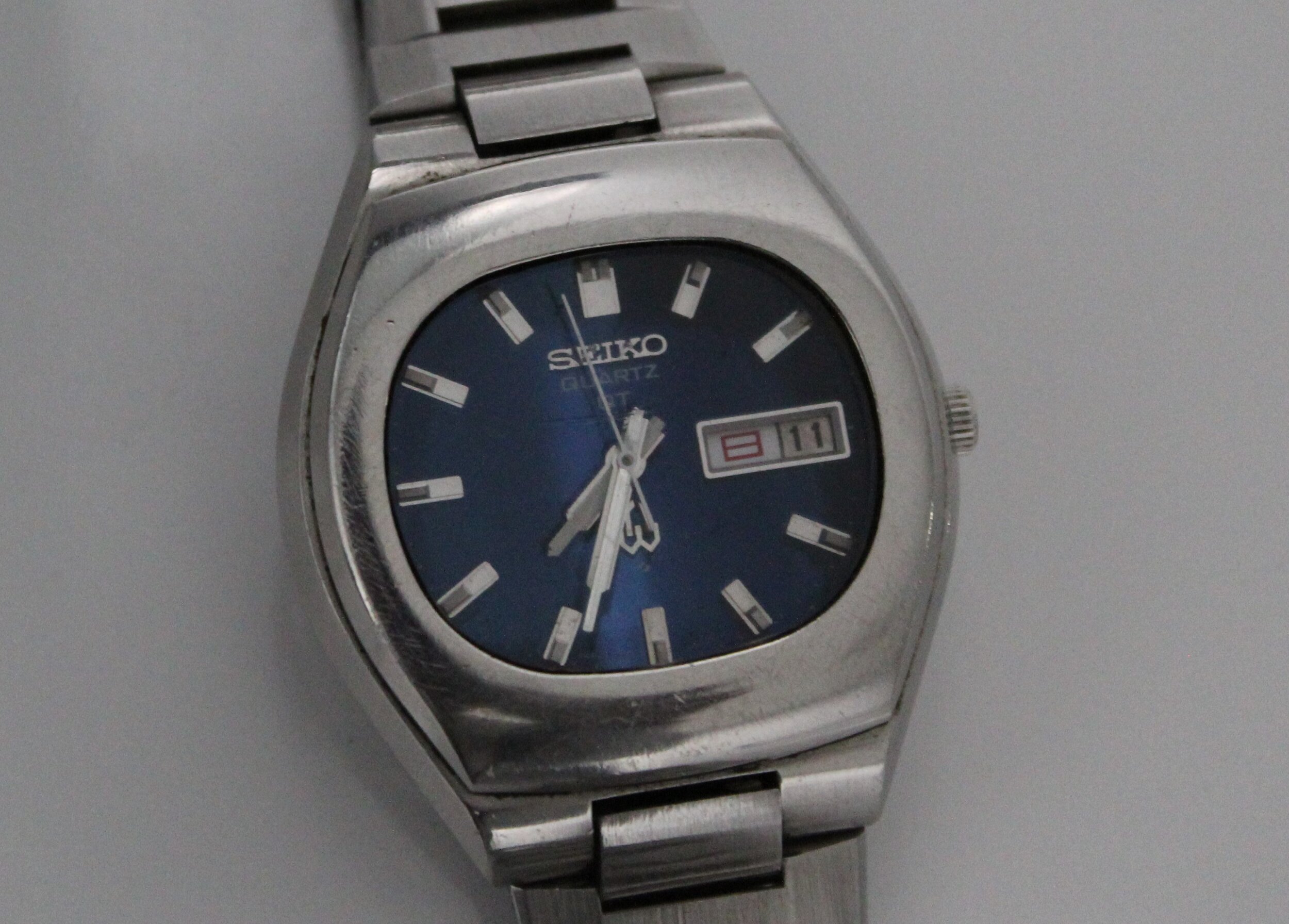
Seiko QT Quartz 3803-5010-G, cost 84,000 Yen in 1975 - also for sale here.
It’s worth noting that some SQ models, those made of gold, for example, reached and exceeded prices of 1,000,000 Yen! There was also one other very rare model, the GFA. That’s right, ‘Greatly Fine Adjusted’. Below is a picture of the 3883-701G, these used the 3883 movement and had a few colorful dial variations.
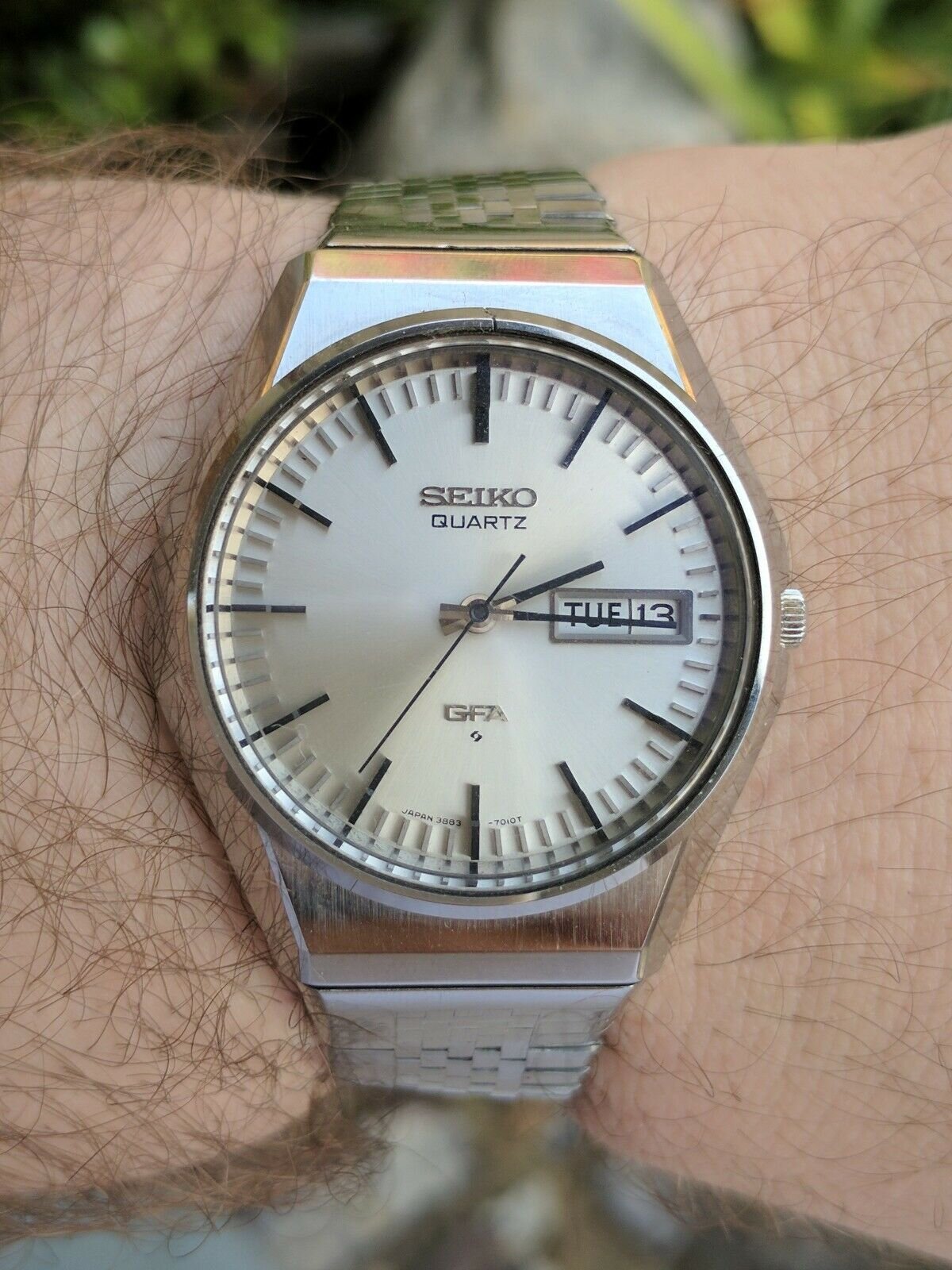
Seiko Quartz GFA 3883-701G / Credit: eBay user seikocitizencollector
Another quirky QT model that was briefly produced in the mid-1970s was the Duo-Time Quartz 3819-7000 ref. 38DQC 010. This was a GMT Seiko Quartz, just like the mechanical Duo-Time.
Apart from these JDM models there were also export models, the SQ 2002, 3003, and 4004 – equivalent to QT, QR, and QZ. These and other SQ models continued to be exported and can be found with date wheels in other languages up until the 1980s. Think 1980s Seiko SQ quartz divers or SQ Sports 100.
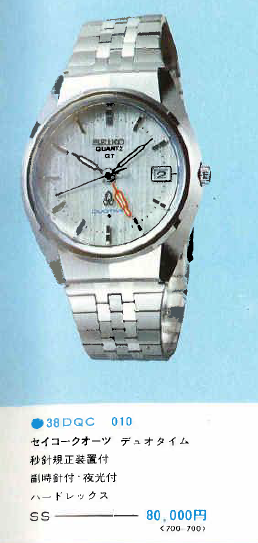
Seiko Duo-Time Quartz 3819-7000 ref. 38DQC 010 from the 1974 JDM catalogue
As the Seiko quartz collection evolved into Grand, King, and Lord Quartz, some QT, QR, and QZ movements largely formed the basis of these. For example, there’s the 08QT, 08QZ and 08KQ or the different ‘38’ movements becoming the 48GQ, 48KQ or the 4883 Superior. In contrast, the QZ movements like the 0903 became the Type II, a now actually affordable quartz model versus the QZ’s prices of 30-40,000 Yen. In fact, in the 1976 JDM catalogue, only the QZ Quartz remains, positioned below the Grand Quartz, King Quartz, and even the 08QZ. The QZ is the longest lasting of the three, ‘Qs’, as the others were out of the catalogue by 1975, but the QZ continued on until 1977 with a few 0922s. 1978 is when the first Lord Quartz first appeared in JDM catalogues, 3 years after the release of the Grand Quartz and King Quartz, replacing the QZ in the former hierarchy as number 3.
These different lines of early Seiko quartz may be overlooked today, but they were the highest end Seikos available in their heyday. And that’s precisely what’s most interesting, most attractive, about these early quartz watches. With prices for Grand Seiko in the four figures, many of these pieces that were once more expensive than the Grand Seikos can be found for less than $200 pretty easily.
By: Andres Ibarguen
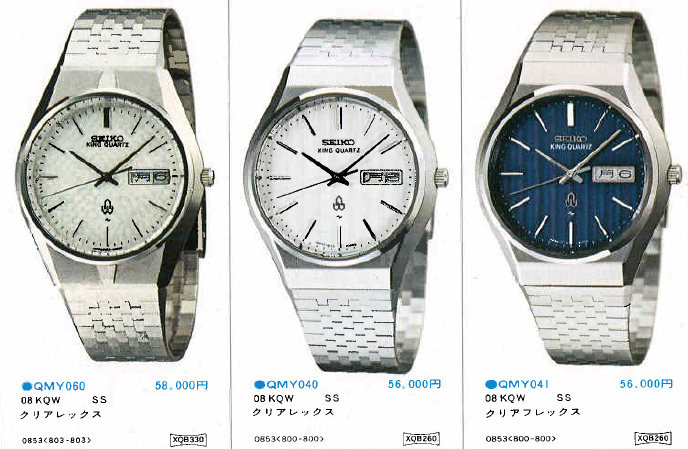
Some 08KQs from the 1976 JDM catalogue
Read more:
“The remarkable achievement of the Seiko Quartz Astron lives on.” Seiko Watches, https://www.seikowatches.com/us-en/products/astron/special/story_qa50th_1/.
See Seiko catalogues from the early 1970s.
“Vol.4 The journey to the ultimate in quartz watchmaking.” Grand Seiko, https://www.grand-seiko.com/in-en/special/10stories/vol4/1/.