
The History of the Seiko Kinetic Movement a.k.a. A.G.S.
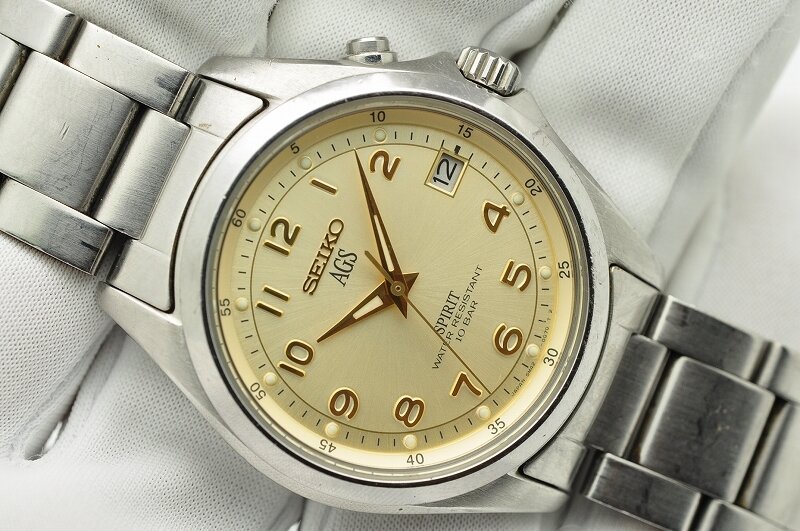
Seiko A.G.S. Spirit 5M42-00E0 / Credit: Aucfan user
The story of what is today known as ‘Seiko Kinetic’ is really one of hard work paying off. What started as an idea in the early 1970s and turned to full-scale development by the early 1980s, finally became reality by the late 1980s and is now a fairly well-known creation by Seiko.
Seiko’s Kinetic movements were originally known as ‘Automatic Generating Quartz’ and released by the company in 1988 under the name ‘Auto-Quartz’, with the Seiko Cal. 7M22. This was the first automatic quartz movement that Seiko made, one that needs only a rechargeable battery, charged by the movement of the wearer’s wrist akin to mechanical automatic movements. Previously, Seiko had developed a solar generated quartz movement (1977) and a manual winding quartz movement (1986), but this new caliber would prove far more practical. The company started development of the Seiko A.G.S. movement in 1983. It was a totally unique invention – the movement of the wearer rotates a rotor that turns a gear train, multiplying the speed of the rotations by 100 and creating a current that charges a capacitor and thus powers the circuits keeping accurate time on the analog display. The first prototype was actually displayed publicly at Baselworld in 1986, although it was not ready for commercial release until 2 years later.
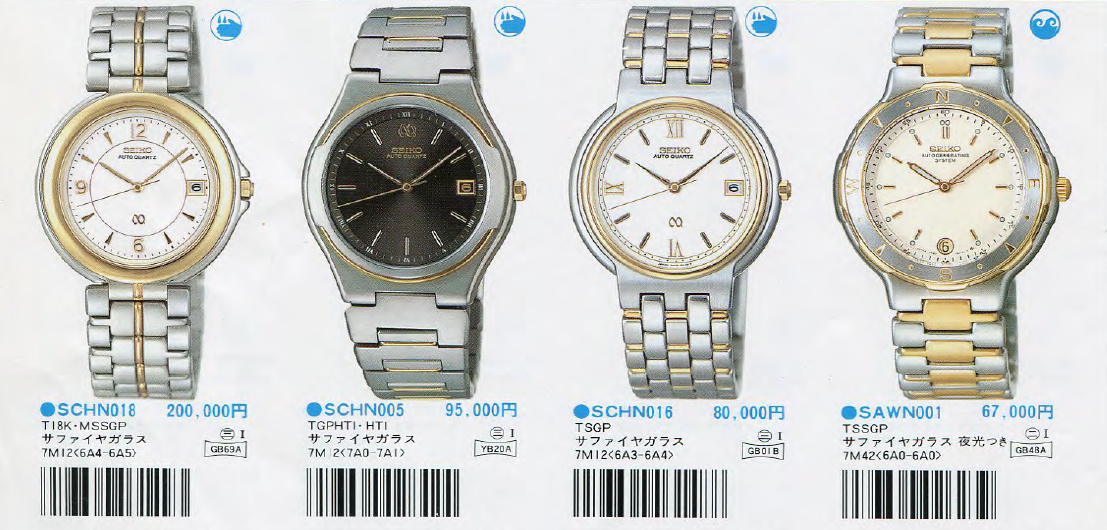
Seiko Auto-Quartz from the 1990 Seiko JDM catalogue
What’s interesting about the Seiko Kinetic movement is that it was also, to some extent, a move towards more sustainable watch production, as no battery was necessarily – this leading to the Seiko Kinetic receiving Germany’s Blue Angel Mark for sustainable products.
In 1997, Seiko changed the name of this collection from ‘Automatic Generation Quartz’ or A.G.S. to Kinetic. This came after many significant updates to the collection throughout the 1990s, like the first Seiko Kinetic Diver in 1992. The late 1990s and early 2000s saw many more important additions to the Seiko Kinetic line. In 1999, the Seiko Kinetic Auto Relay was introduced, an innovative feature that allowed the wearer to ‘pause’ the watch at a certain time (and save energy), still keeping track of the time while ‘paused’, and ‘unpause’ with just a few shakes – immediately snapping to the current, correct time. A bit late to the party, the first Seiko Kinetic chronograph was released in 2000.
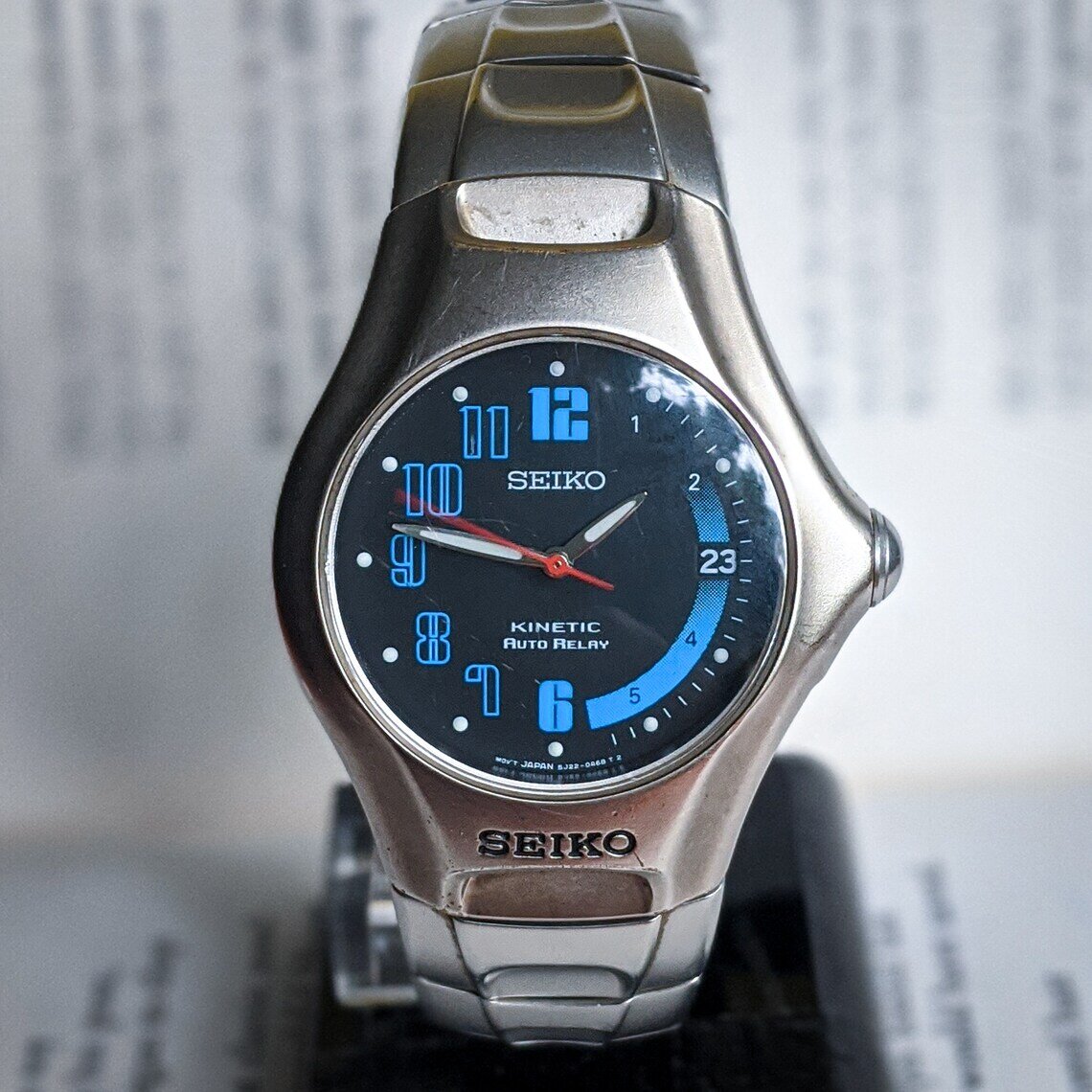
Seiko Auto Relay 5J22-0A90 / Credit: TempusAntiquus
So, while an interesting innovation in the larger Seiko Quartz family, the Seiko Kinetic was also part of Seiko’s attempt to create more environmentally friendly, or at least energy-efficient, timepieces! Take the Seiko Thermic as another, more peculiar example of this trend at Seiko at the time. Released in 1998, the Seiko Thermic generated electricity by using the difference in temperature between the wrist of the wearer and the watch case…Not exactly practical but still an interesting technology.
By: Andres Ibarguen
Read more:
“The Seiko AGS Quartz Watch.” Epson, https://global.epson.com/company/corporate_history/milestone_products/pdf/19_ags.pdf.
“Our Heritage.” Seiko, https://www.seikowatches.com/global-en/special/heritage/.
A Journey in Time, the Remarkable Story of Seiko. Seiko Watch Corporation. January 1st, 2003.
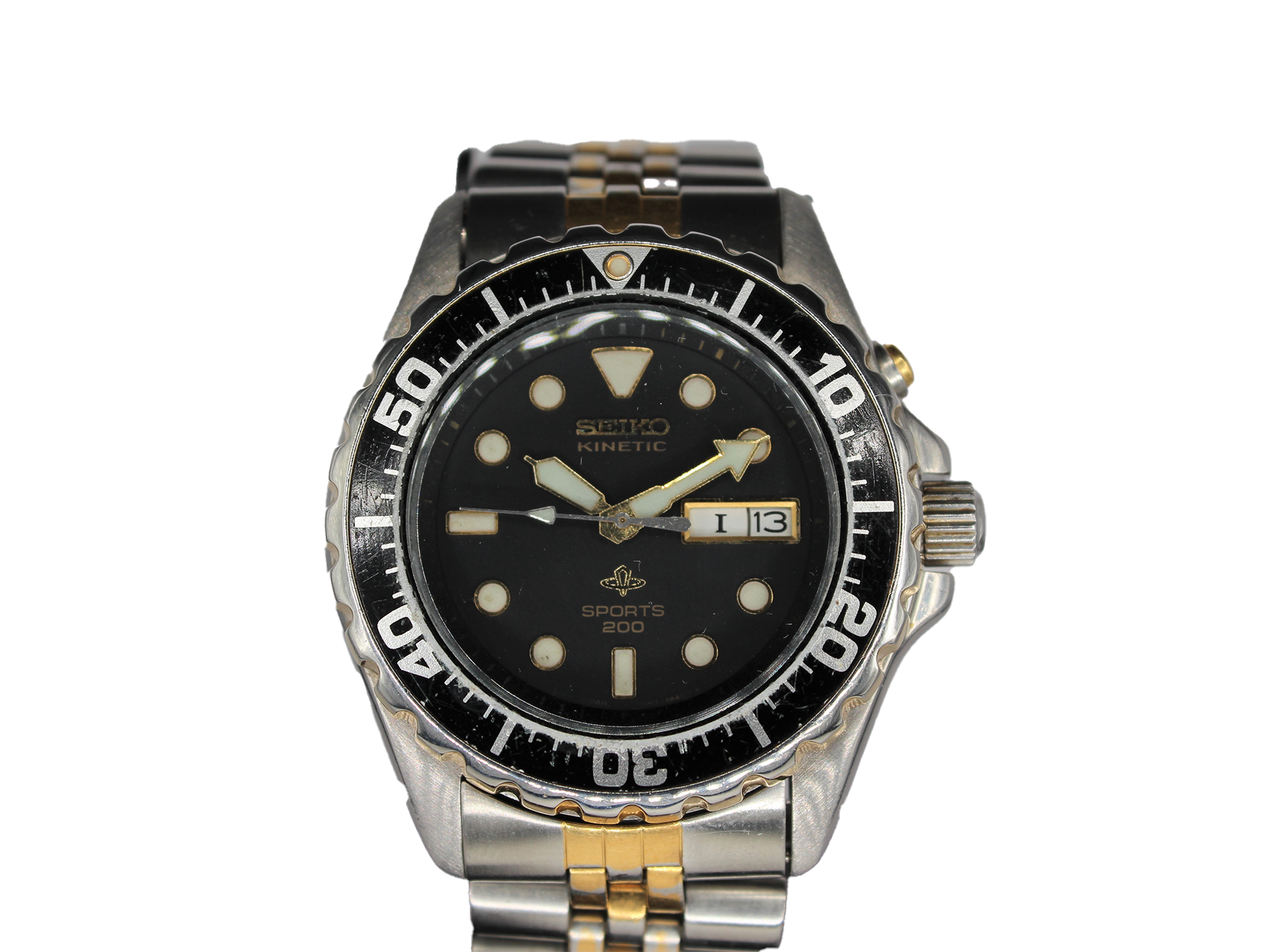
A Seiko Kinetic Diver ref. SKJ004 for sale on Toronto Vintage Watches.
Editor’s note (20/08/2021): The article was updated noting that the Kinetic movement’s battery is rechargeable.