
Including a look at the Seiko Business Bell and Business-A
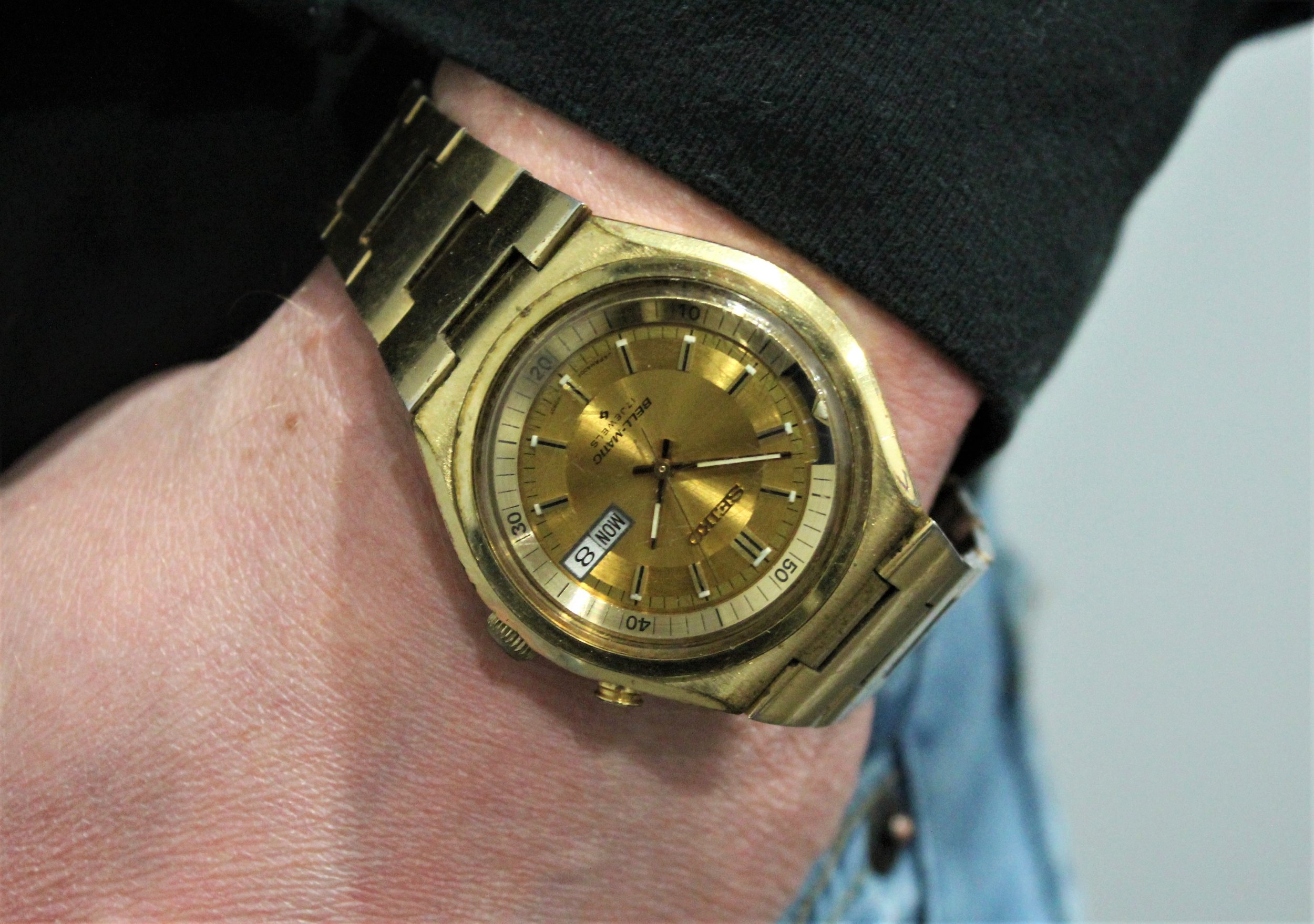
A vintage Seiko Bell-Matic 4006-6040 from November 1972. For sale on Toronto Vintage Watches.
While the history of alarm clocks technically goes back to ancient water clocks, it was really in the late 1940s and early 1950s that they became commercially popular, with the Vulcain Cricket and the Jaeger-LeCoultre Memovox being released.
These models were very successful, worn by world leaders and celebrities alike. However, while this was going on, across the world, Seiko was working on its own alarm wristwatch movement. Now, Jaeger-LeCoultre beat Seiko to the punch by about a decade, developing the Jaeger-LeCoultre Memovox Automatic in 1956. Officially the first automatic alarm wristwatch, featuring the Caliber K815.
Seiko instead released their first Bell-Matic movement in 1966, the Cal. 4006, paired with the 7000 cases. They later released the Cal. 4005, but only briefly in the late 1960s. The Seiko Bell-Matic’s Cal. 4005 was date-only, versus the Seiko Cal. 4006 that was day/date.

The Seiko Bell-Matic’s internal mechanism
The Seiko caliber used a small hammer that struck a curved metal sounding spring, powered by a spring itself. The Seiko uses two barrels for storing power, like its Swiss counterparts, that maintain a separate power reserve for the alarm and the timekeeping functions. The Seiko Cal. 4006 has no manual winding function and relies solely on the movements of the wearer’s wrist to power the Seiko Bell-Matic. The alarm indicator for the Bell-Matic was a tracked along the inter bezel.
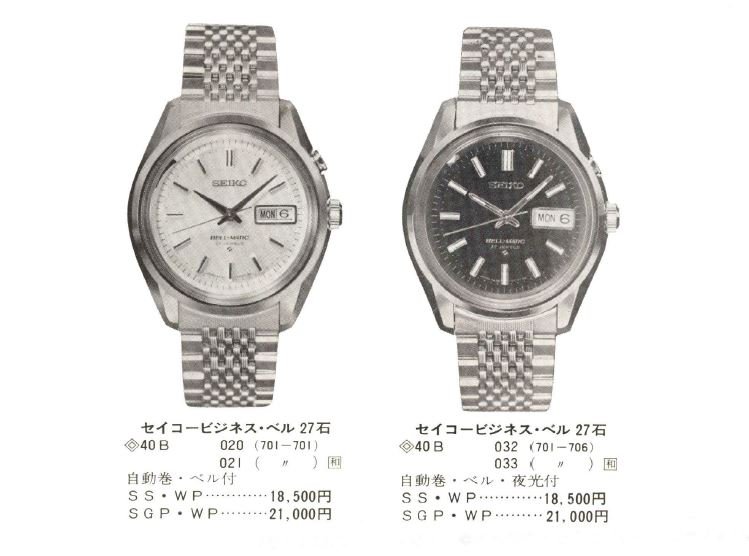
Seiko Bell-Matics from the 1968 JDM catalogue
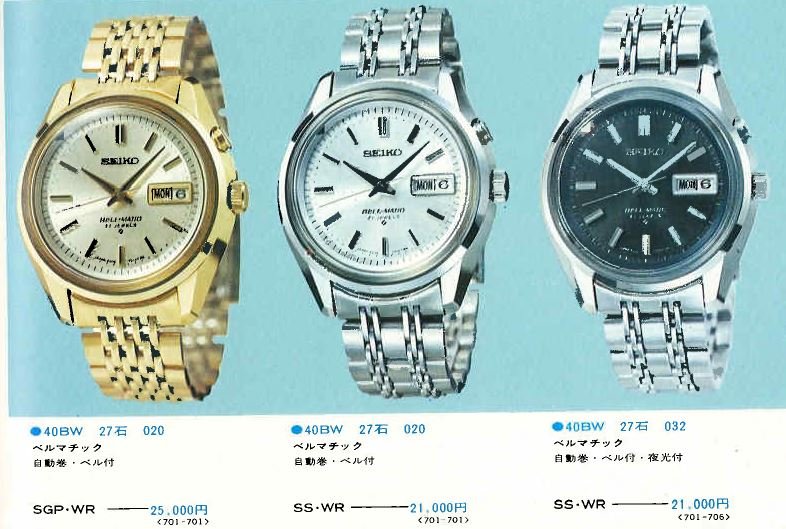
Seiko Bell-Matics from the 1974 JDM catalogue
The most notable iteration of the Seiko Bell-Matic was the Seiko Business Bell – only produced briefly in the late 1960s and related to the Seiko Business-A. The Seiko Business-A was a line of automatic Seikos produced in the 1960s for business people, marketed to young professionals. It was produced for only a short period of time, first circa 1966 and gone from the Seiko JDM catalogue by 1970. These watches were produced with a couple different movements. Namely, the Seiko Cal. 8306 was related to the same movement used in the Seikomatic-R and was the 30-jewel version to the 27-jewel Seiko Cal. 8346, also used in the Seiko Business-A. The Seiko Cal. 8346 would be in the upper-middle range of Seiko movements, comparable to the ’62’ family of calibers. Interestingly, the Seiko Business-As that featured these movements were often marked 8306/46 on the back, as these cases were used for both models of watches. The base of these movements being the Cal. 830 produced between the early 1960s and 1970s.
Ultimately, the Seiko Bell-Matic was a very popular and relatively long-lived model Seiko produced in the 1960s and 1970s. Made in high quantities and in many different variations, today it is not overly difficult to find a good condition Seiko Bell-Matic – depending on your preference in terms of the different configurations and movements it came with.
By: Andres Ibarguen
Read more:
“The Memovox Adventure” Jaeger-LeCoultre, March 14th, 2018, https://press.jaeger-lecoultre.com/the-memovox-adventure/#:~:text=Memovox%20Automatic,audience%20of%20its%20alarm%20watch.
Flett, David. “Seiko Bell-Matic – The Complete Guide.” Beyond the Dial, July 10th, 2020, https://www.beyondthedial.com/post/seiko-bell-matic-the-complete-guide/.
See late 1960s/1970 Seiko JDM catalogues.
“Seiko 830 Caliber.” Retro Seiko, https://retroseiko.co.uk/single.htm?model=830.

A 1972 vintage Seiko Bell-Matic 4006-6040 on its original bracelet, for sale on TVW.