
Did Martel Make the Universal Genève Tri-Compax?

Universal Genève Tri-Compax / Credit: Amsterdam Vintage Watches
The story of the Universal Genève Tri-Compax is somewhat jumbled up. Starting with the year of its release – 1944 – which was a particularly tumultuous year for the world. D-Day, the liberation of Paris and Guam, and Iwo Jima, were just some of the wild ongoings of 1944.
Also, in 1944, over in neutral Switzerland, Baselworld was alive and well. That year, at the famous trade fair, Universal Genève released the Tri-Compax, right at the end of the Second World War.
The Universal Genève Tri-Compax is part of the wider Compax collection from Universal Genève, which started up in 1936 with the Compax (although the similar Compur was released a couple years earlier). The Tri-Compax was the pinnacle of the Compax collection and is named after its three functions of calendar, chronograph, and moonphase. It was a technical marvel upon its release and a successful watch for the brand. Early models used the Universal Genève Cal. 287 and 481, which were modified Martel movements, also shared with Zenith at the time. It is worthwhile to note that the Cal. 287 is supposed to be the same as the Zenith Cal. 156, while the Universal Genève Cal. 481 is based off of the earlier Cal. 281; which would coincide with the Zenith 122. Zenith would have been a customer of Universal Genève at the time, who had a close and uncertain relationship with Martel. Although it is clear that Martel made movements for Universal Genève, it must be said that Martel’s role in Universal Genève’s movement making has been a point of contention and confusion. Some sources indicate that Universal Genève’s chronograph production was entirely in-house throughout the 1930s and 1940s…but patents (retrieved from a famous Watchuseek thread) show otherwise. Moreover, it is possible that Universal Genève held stock of Martel’s or may have had an exclusive deal for their chronograph movements. In any event, the key fact is that Martel did make movements for Universal Genève.
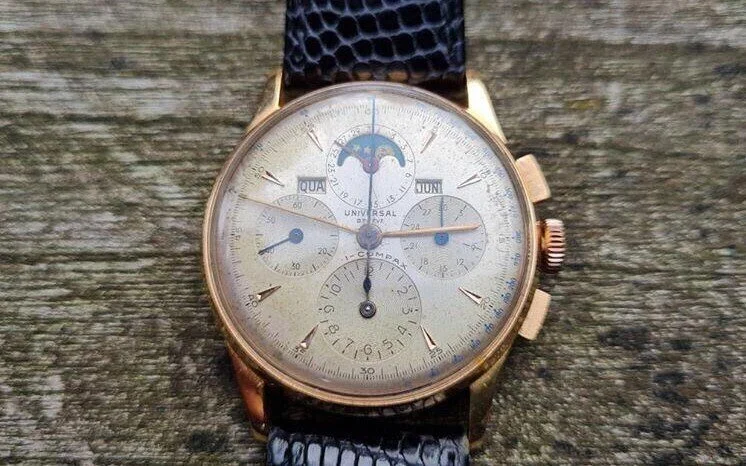
A Universal Genève Tri-Compax ref. 12266
The relationship between the three companies: Zenith, Martel, and Universal Genève, goes back further than just the Tri-Compax. Even a couple years before they are said to have worked on the Dato-Compax together. Nonetheless, Zenith also produced its own ‘Compax’ and even ‘Tri-Compax’ models, using the movements mentioned above. They would have received movements from Martel (presumably via Universal Genève), until they acquired Martel in the late 1950s.
For a company that marketed themselves as the “World’s largest maker of chronograph watches…” well into the 1960s, the Tri-Compax was truly Universal Genève’s crowning achievement, and a watch that was undeniably advanced for the time. However, it was not totally unique or totally theirs. Martel, who had supplied the Tri-Compax with its movement, started to produce similar contraptions when it hit an independent streak some years down the line. And, of course, Zenith had also made a Tri-Compax also using Martel base movements. So, although the Tri-Compax is an achievement credited to Universal Genève, there is some credit to go around, particularly for Martel. In fact, this just makes me want a Martel so I can nerd-out whenever someone asks me what it is.

Old Martel ad
Today, while Zenith is alive and well, having beat its competitor and former partner to the punch with the El Primero in 1969, Universal Genève is but a shadow of its former self. The Tri-Compax was produced until the end of the 20th century, even after Bulova had already acquired Universal Genève in the 1960s, but ultimately, the company and the watch would never recover. And all we have left today are the vintage models whose prices only continue to increase.
By: Andres Ibarguen