
The Best Vintage Rolex Advertisements
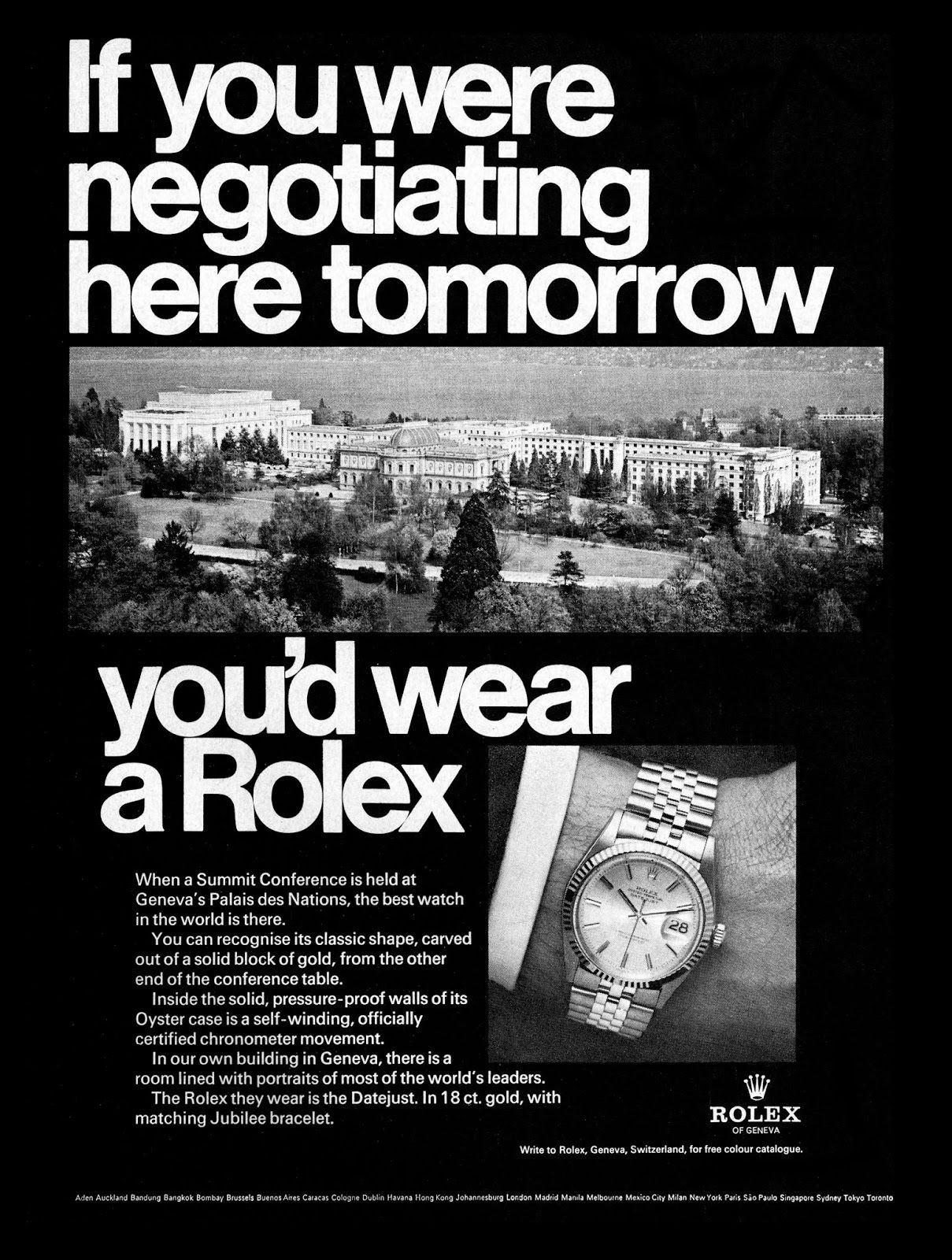
Vintage Rolex Datejust advertisement
The Rolex Explorer Matterhorn Advertisement
We built the Rolex Explorer because there isn't any watch repair shop on top of the Matterhorn.

Vintage Rolex Explorer Advertisement
This is the watch we engineered for the lonely places. We carve its case out of a single block of Swedish steel so there are no seems to come apart. We test it at minus 50° and plus 150° F. We subject it to an underwater pressure of 330 feet. We then have an official Swiss Institute for Chronometer Tests double-check the accuracy of its 26-jewel movement for 15 days and 15 nights. If it passes, the institute gives it a certificate guaranteeing “especially good results.” Then, and only then, do we sell it. The Explorer sells for $180 (with authentic Rolex bracelet, $195) at fine jewelry shops. Other waterproof, self-winding chronometers from $175.
The Rolex Submariner Black Tie Advertisement
We invented the Submariner to work perfectly 660 feet under the sea. It seems to work pretty well at any level.

Vintage Rolex Submariner Advertisement
The Rolex Submariner is a salty watch. It's the official watch for divers of the Royal Navy. That beefed-up Oyster case resists pressures down to 660 feet. You'll find it in the cockpits of most ocean racers as hard-driving skippers beat down to Bermuda, Hobart and the Fastnet Rock. How come it's seen so much where the wettest thing around is a dry Martini? Who knows. Maybe it's because the black dial goes so well with a black tie. Ask her. Maybe she knows. ROLEX. When a man has a world in his hands, you expect to find a Rolex on his wrist
Rolex Everest Oysterquartz Advertisement
In 1953 they used Rolex Oysters and oxygen on Everest. In 1978 they managed without the oxygen.

Vintage Rolex Oysterquartz Advertisement
In 1953, the man on the left of our picture became the first person to set foot on the top of Everest. His name: Sir Edmund Hillary. Together with Sherpa Tensing, he made the final victorious assault on the world's highest mountain. To have battled that far against the cold, altitude, and sudden dramatic shifts in weather unique to Everest was achievement enough. But when you realize that each member of the team carried up to 50 lbs. of equipment, it becomes not so much a feat of skill as one of endurance. For example, each oxygen pack-at that time considered essential for climbers at that altitude weighed 20 lbs. One item which weighed rather less was the Rolex watch with which each member was equipped. Lord Hunt, leader of the historic British expedition, wrote after-wards: "We have indeed come to look upon Rolex Oysters as an essential part of our high-climbing equipment.” Exactly 25 years later, the Italian Reinhold Messner, on the right of our picture, climbed Everest by the same route (including a section called The Hillary Step). But what singled out his achievement from all the successful Everest expeditions since 1953 was that it was performed without the use of oxygen. If there was any doubt before (and there was little among the mountaineering fraternity) this climb ranks Messner as one of the world's greatest living climbers.
He has now become the first man to make five ascents over 8,000 meters, all without the aid of oxygen. In many ways, the equipment and techniques used by modern-day mountaineers have changed dramatically since the days of Hillary and Hunt. And it is only the speed of the climber, the light construction of his clothing and gear, together with a degree of fitness comparable to that of a top athlete which enables him to withstand the effects of altitude sickness. And Messner's choice of a Rolex was typical of his obsessional attention to detail, so critical to such a climb. His Rolex Oysterquartz functioned perfectly throughout the expedition. It was entirely appropriate that the first person to meet Messner and his partner, Peter Habeler, on their return to base camp was none other than Sir Edmund Hillary. ROLEX.
‘If you were’ Rolex Submariner and Rolex GMT-Master Advertisements
If you were racing here tomorrow, you’d wear a Rolex. If you were flying the Concorde tomorrow, you’d wear a Rolex.

Vintage Rolex Submariner and Rolex GMT-Master Advertisement
Some of the world's best sailors wear a watch they call the best in the world. Their reason for buckling on this anchor weight timepiece is simple. Its Oyster case is carved out of a solid block of hardened Swedish stainless steel. And its winding crown screws down like a miniature submarine hatch. So it's immensely strong. And it doesn't leak. Ever. So much of the work is done by hand, each Rolex Oyster takes more than a year to make. Some Olympic sailors feel it was time well spent. The watch they wore while winning gold medals at Acapulco last October was the Rolex Submariner.
One essential piece of equipment in Pan Am's Concordes weighs nearly a quarter of a pound. Which may seem a bit heavy for a watch. But its Oyster case is carved from a solid block of hardened Swedish stainless steel (carved from 18 kt. gold it weighs even more). Inside its solid walls is a rotor self winding officially certified chronometer. And outside, its big honest face tells the time in two time zones at once. And the date. So much of the work is done by hand, it takes us more than a year to build a Rolex. However, the Pan Am pilots who will fly the Concorde are rigorously demanding about the performance of their watch. So if a Rolex weren't so heavy ... it wouldn’t fly. The Rolex Pan Am pilots wear is the Rolex GMT-Master. In 18kt. gold with matching Jubilee bracelet $1375. In steel $295.
Perfection.
By: Eric Mulder