

A design icon, a watch worn by celebrities and artists, that even sells for six-figures in auction nowadays – the Cartier Crash is quite the unique timepiece. Its history goes back to the Swinging Sixties, a watch design conceived in Cartier’s original London flagship boutique on Bond Street, very representative of the decade it was made in.

Salvador Dali’s The Persistence of Time, said to be the inspiration for the Cartier Crash
The iconic design of the Cartier Crash is said to have come from Jean-Jacques Cartier’s work with Rupert Emmerson. Jean-Jacques was the great-grandson of Cartier’s founder, Louis-François, and Rupert Emmerson was a well-known artisan at the time. Another theory is also that the design was inspired by Salvador Dali’s The Persistence of Memory, that Dali painted in 1931. Although…a third theory stipulates that it was originally a Cartier Baignoire gone wrong… Nonetheless the design was very risqué and is today often seen on the wrists of artists and entertainers like Kanye West and Tyler the Creator. The Sixties was, of course, a wild time for many reasons. Culturally, events like Woodstock and bands like the Beatles had a massive impact, and this also extended to fashion and design. The Cartier Crash was first released in 1967 and originally featured a Jaeger-LeCoultre movement signed by Cartier. The watch had to be made by hand due to the case shape, this unique production challenge leading to it being produced sparingly in the 1960s, ‘80s, and ‘90s. It’s also the reason for the price. Over the years, a limited edition of the Cartier Crash Skeleton was also produced. According to information from Rupert Emmerson, Jean-Jacques originally didn’t approve of the Cartier Crash, but changed his mind when he saw how customers reacted!
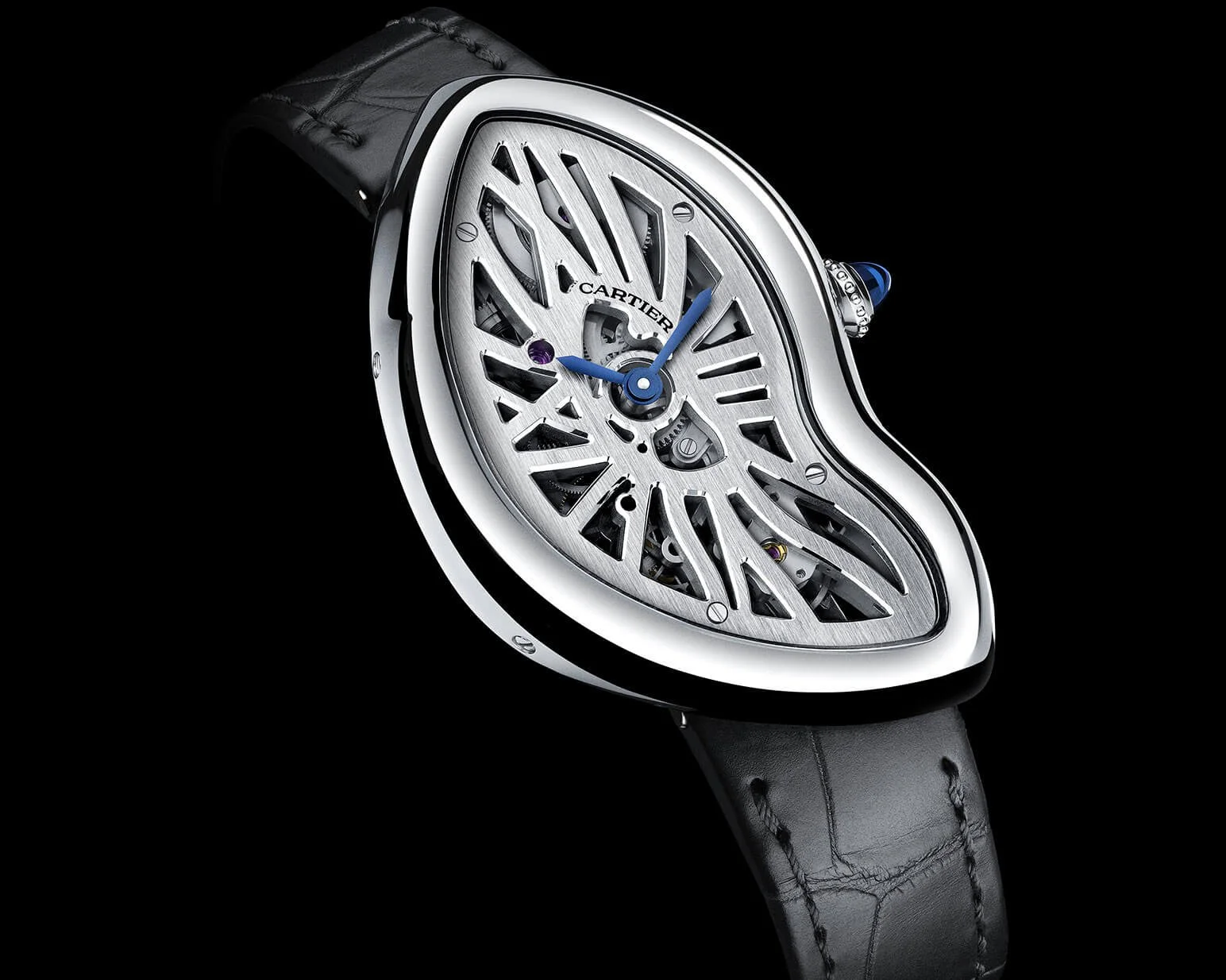
A Cartier Crash Skeleton
The first watches were made from Cartier London, but the edition released in 1991 was made by Cartier Paris, a notable selling point for these later Cartier Crashes. By the mid-1990s, the Cartier Crash was no more. More recently, in the early 2010s, the Cartier Crash Skeleton was released, powered by the manual winding 35-jewel and 72-hour power reserve Cartier caliber 9618 MC. Just a couple years ago, in 2019, the Cartier Crash ref. WGCH0006 was released for their London boutique – a normal, non-skeleton edition of the Cartier Crash much like the 1980s and 1990s ones. This one is powered by a manual winding Cartier caliber 8971MC, with only 15 pieces made. The latest Cartier Crash being the rarest if not for the original from the late 1960s.
Ultimately a very curious timepiece, from inception made to be rare and not for any marketing tactic but truly for the effort that went into making them.
By: Andres Ibarguen
Read more:
“The Cartier Crash: A Radical Icon In Demand.” Phillips, https://www.phillips.com/article/66271400/the-cartier-crash-a-radical-icon-in-demand.
“The Cartier Crash.” Phillips, https://www.phillips.com/article/17561456/the-cartier-london-crash-watch.
Muraj, Evald. “Introducing the Cartier Crash Skeleton, An Icon Reimagined.” Hodinkee, December 10th, 2014, https://www.hodinkee.com/articles/introducing-the-cartier-crash-skeleton.
Su, Jx. “Cartier Introduces Crash Reissue Exclusive to London Boutique.” Watches by SJX, December 20th, 2018, https://watchesbysjx.com/2018/12/cartier-crash-bond-street.html.

A vintage Seiko Lord Matic Special from 1974, for sale on Toronto Vintage Watches.