

Albert Einstein was known as a physicist, a genius, and many other things. However, he has never been known as a watch collector...and probably never will be, as he only owned three timepieces that we know of in his life. While the three-watch collection may be an oft-debated topic in horology circles, Einstein's three each have a particular back story. He owned: a silver pocket watch from 1900 sold by Christie’s in 2016, a 1930 Longines wristwatch sold by Antiquorum in 2008, and 1943 Longines pocket watch in the hands of the Bernisches Historisches Museum.
Back in 1900, when the first watch was produced, Einstein would’ve been a student, in fact he was actually stateless until 1901. After dropping out of high school Einstein was accept into what became ETH Zürich under the condition that he made up for his missed schooling.
This pocket watch was sold by Christie’s in 2016, it is a 15-jewel silver Swiss pocket watch with Arabic numerals and a gilt dial. The watch was is said to have been given directly by Albert Einstein to the anonymous person who sold it in auction for about $375,000.
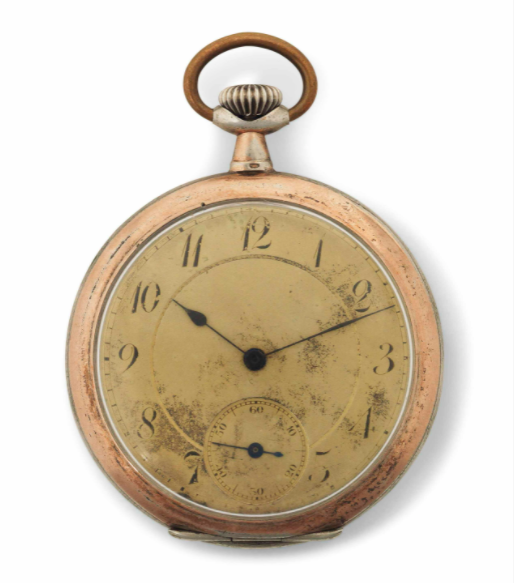
Einstein’s silver pocket watch ca. 1900 / Credit: Christie’s
Now, Einstein is famous for many things, but for scientists what usually signifies the peak of their success is a Nobel prize, which Einstein won for physics in 1921. His general theory of relativity was complete by 1915, while already teaching at the Karl Wilhelm Institute in Berlin. Although that may be his most remembered contribution, what he won the Nobel prize for was "for his services to Theoretical Physics, and especially for his discovery of the law of the photoelectric effect."
Albert Einstein was now a global star and his travels ended up taking him to Los Angeles in February 1931. This is where we meet the second timepiece in Einstein’s life, a Longines wristwatch manufactured in 1930 and gifted to him by Edgar Magnin. Magnin was the rabbi of Congregation B'nai B'rith, the oldest Jewish congregation in Los Angeles. He gifted Einstein and his wife each timepieces when they went to visit the city in early 1931, as a symbol of appreciation from the Jewish community. Albert received a 14k yellow gold Art Deco Longines wristwatch, very much in line with the design at the time of its conception in 1930, featuring a manual winding 17-jewel Cal. 10.86 N.

Einstein’s Longines Art Deco wristwatch / Credit: Antiquorum

Albert Einstein / Credit: Ferdinand Schmutzer
The last and final watch is in the Bernisches Historisches Museum. Interestingly, we’ve written about Bern before, specifically the Zytglogge, which is said to have inspired Einstein’s inquiry into the general theory of relativity!
Now, long after Einstein’s days of living in Bern as a young man, this third Longines was made in 1943 and bought in 1946. It was then given by Einstein to his son and eventually gifted to diplomat Henry Bovay by Einstein’s daughter-in-law, who was then a widow. Finally, Bovay gave it to the museum, where it resides today.
By: Andres Ibarguen
Read more:
“[EINSTEIN, Albert (1879-1955)].” Christie’s, https://www.christies.com/en/lot/lot-6012466.
“Lot 286.” Antiquorum, https://catalog.antiquorum.swiss/en/lots/lot-208-286.
“ALBERT EINSTEIN’S LONGINES WATCH ON DISPLAY AT THE HISTORISCHES MUSEUM IN BERN, SWITZERLAND.” Europa Star, June 2005, https://www.europastar.com/news/1000970121-albert-einstein-s-longines-watch-on-display-at.html. Credit to Europa Star.
Kaku, Michio. “Albert Einstein.” Encyclopedia Britannica, https://www.britannica.com/biography/Albert-Einstein.
“The Nobel Prize in Physics 1921.” Nobel Prize, https://www.nobelprize.org/prizes/physics/1921/summary/.
AP. “Rabbi Edgar F. Magnin.” The New York Times, July 19th, 1984, https://www.nytimes.com/1984/07/19/obituaries/rabbi-edgar-f-magnin.html.
Bleiberg, Larry. “The clock that changed the meaning of time.” BBC, September 7th, 2016, http://www.bbc.com/travel/story/20160901-the-clock-that-changed-the-meaning-of-time.

A vintage Tissot Seastar Automatic ref. A550-X on its original Bracelet, available here.