

Tissot really came back on the scene this year with the release of the PRX, a hit online and a beautiful watch. It was really unexpected that this day in age the watch world would have affection for a quartz watch, but Tissot ‘broke the glass ceiling’ with what is arguably their first noteworthy release in decades.
There are not too many vintage Tissot models that stand out as pieces known for their collectability. Sure, there are some divers, chronographs, and of course the Seastars, but in general Tissot has always been a bit of an afterthought.
Tissot’s history goes back to the original name, Charles-Félicien Tissot & Fils, founded on July 1st, 1853 in Le Locle, Switzerland. The name comes from father son duo Charles-Félicien Tissot, a casemaker, and his son Charles-Emile Tissot, a watchmaker. The pair transformed their home at the time into the Tissot factory back in 1853.
Charles-Félicien was born in 1804 in Le Locle and also lived in Valangin. He married Julie in town and had his first daughter in 1928, with Charles-Emile being born in 1830. The elder Tissot specialized in gold-casemaking, producing cases for pocket watches from their home. Their house (on Crêt-Vaillant) also hosted the guillochage of a Mr. Grivaz.
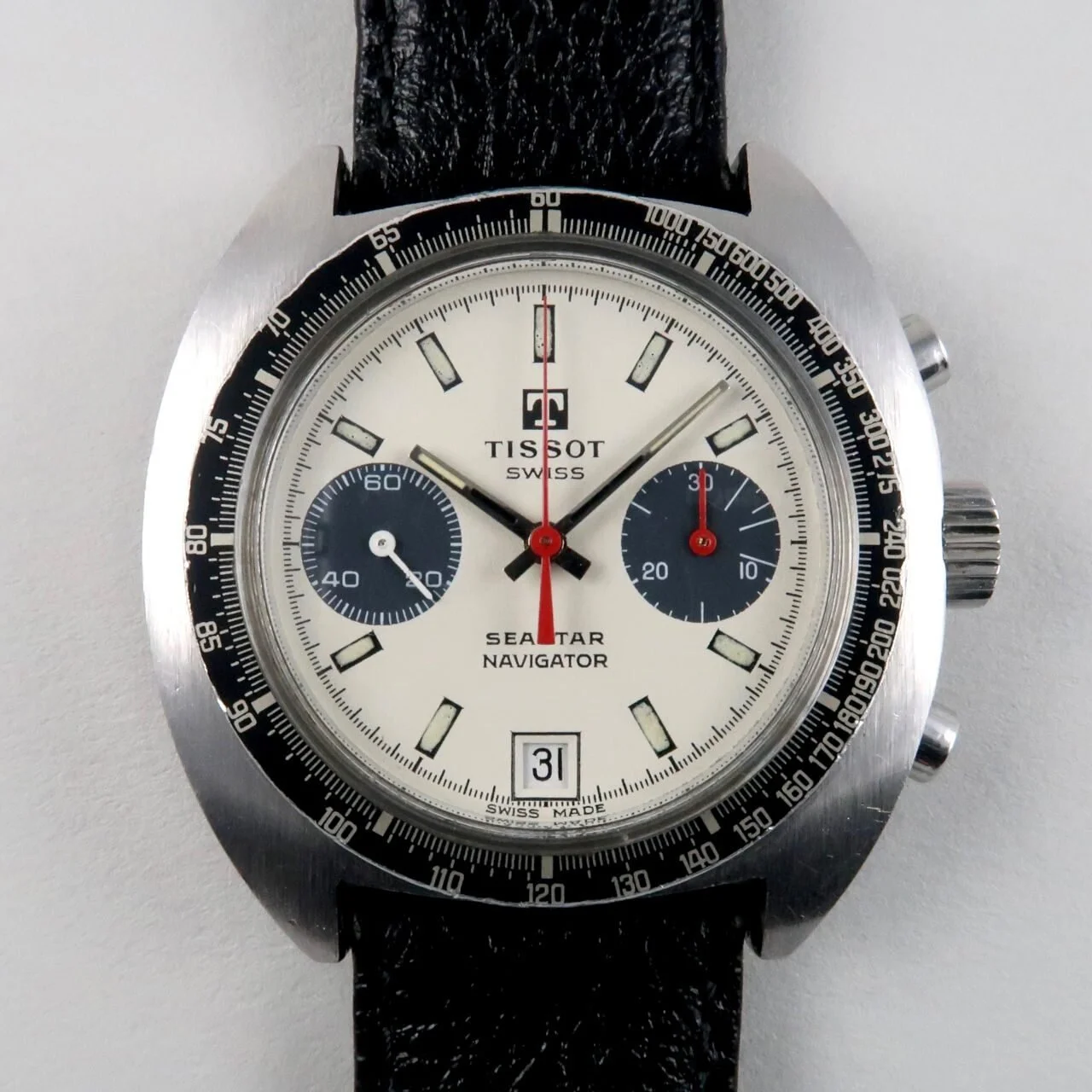
Tissot Seastar Navigator ref. 40522 / Credit: Black Bough
At the early age of 12, Charles-Emile expressed his interest in becoming a watchmaker – to the delight of both of his parents. The boy, now older in the late 1840s, also traveled to New York to work in his uncle’s repair shop – learning the trade and deepening his passion for it.
Upon the foundation of the family’s new enterprise, they quickly hired watchmakers to work on all aspects of their timepieces – still working out of the family home turned workshop. In 1865, the company changed its name for the first time to Tissot & Fils. Then, in 1873, with the death of the founder and patriarch Charles-Félicien, the company name was changed to Charles Tissot Favre in honour of Charles-Emile and Françoise Sophie Amélie’s marriage that year.

Charles-Félicien Tissot pictured
Another name change came in 1917, during WWI, now to Tissot & Fils SA. In 1925, in a preamble to becoming part of SSIH in 1930, the company signed a commercial agreement with Louis and Gustave Brandt, brothers who were directors of Omega.
Now the story of Tissot in the later half of the 20th century is another story, exchanging hands several times between landing in the Swatch Group. Ultimately, however, Tissot started off as a veritable family business, a garage start-up even, and grew to become an industry powerhouse. While the company created many different mechanisms in-house and a variety of models at different times – including their very own Tissot Marine that they released in tandem with the original Omega Marine – I would say that the PRX is probably the way forward for the company.
By: Andres Ibarguen
Read more:
Fallet, Estelle. The story of a watch company. Le Locle. Tissot. 2002.

Tissot Seastar ref. A-550X for sale here.