
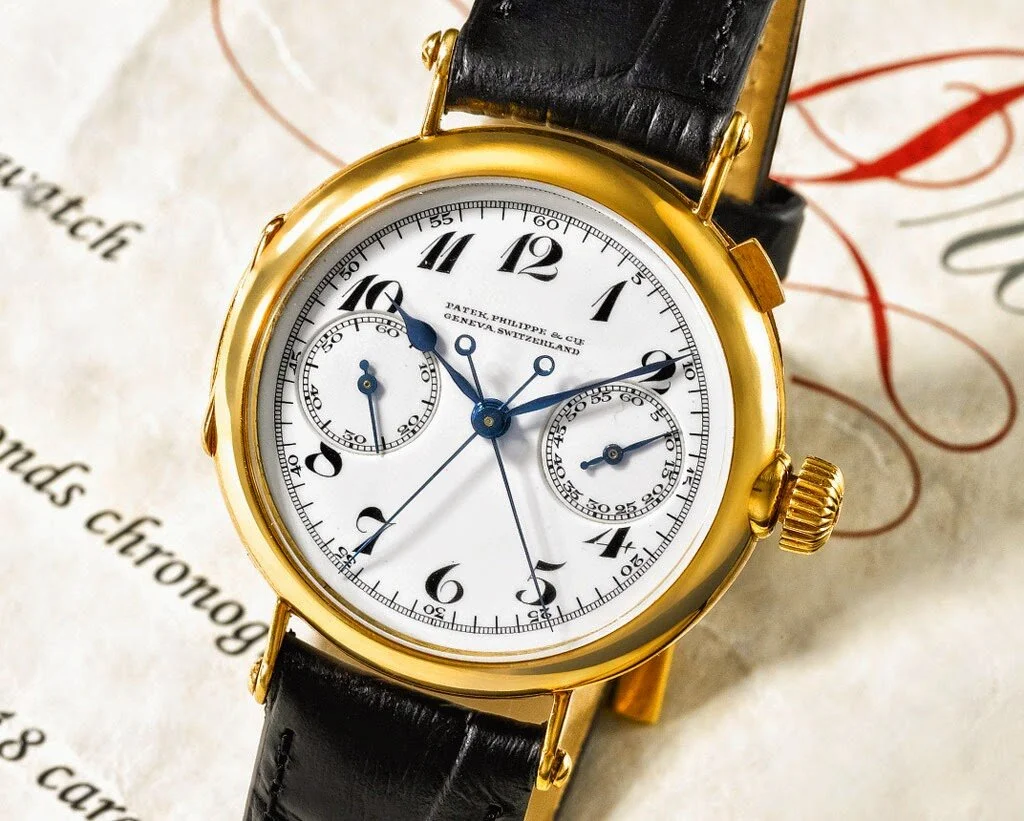
Previous to the 1900s Patek was mostly known for its pocket watches, as they were more popular and widely used by the public. They were commissioned to make great works for aristocrats around Europe – gaining fame as a brand themselves. From the early 20th century Patek Philippe produced wristwatches with some early references often being purchased back from the Patek Philippe Museum in recent times. Today, Patek Philippe is mostly known for its wristwatches, but it is worthwhile to explore some of their earlier works.
One wonderful example of this is the 1923 Patek Officer watch no. 124,824. This is a timepiece manufactured in 1923 and known as the earliest example of a split-seconds wrist chronograph in existence. This watch sold for almost $3 million in 2014 to the Patek Philippe Museum. It was commissioned, however, all the way back in 1903 – right at the start of the century – and only delivered in 1923. The watch had previously sold for about $2 million in a 1999 Antiquorum auction.
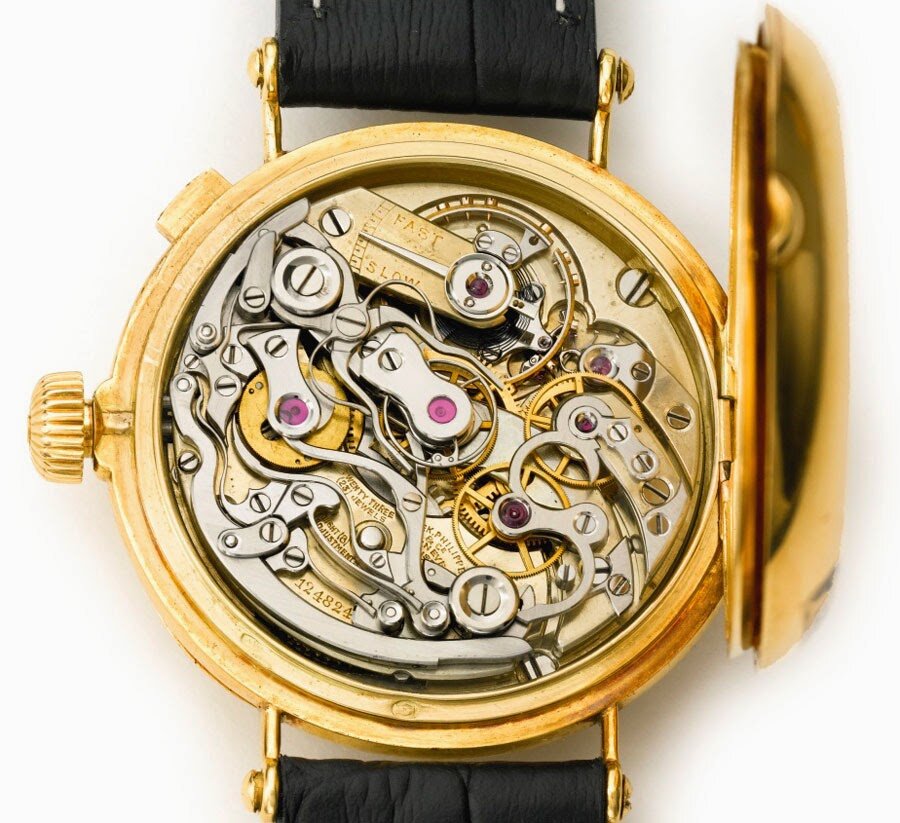
Patek Philippe 1923 Officer watch’s movement no. 124,824 / Credit: Sotheby’s
Staying in the 1920s, another early interesting Patek that sold for over $2 million at Christie’s in 2006 is another split-seconds chronograph produced in 1925. This wrist chronograph featured the movement no. 198,012 and was retailed by Grogan Co. in Pittsburgh, Pennsylvania. Most importantly, this timepiece is said to be the sole wristwatch made for a left-handed wearer by Patek Philippe. Making it even more unique.
These two are highly representative of some of the early wristwatch work done by Patek Philippe – and of their early work in general – as they continued the tradition of producing timepieces that were commissioned by different clients.

Patek Philippe ref. 524 / Credit: Christie’s
Turning, instead, to the 1930s, we get to some of their more widely distributed timepieces and some of the interesting quirks of the day. The ref. 524 is one of such wristwatches that was popular in the mid/late 1930s and indeed quite quirky. This is not at all as elusive as the 1923 Patek Officer or the Grogan but still goes for about $25,000 in auction. What was unique about the ref. 524 was its curved or asymmetrical case, created in such a fashion that it made it easier to view the time while driving. An early driving watch actually made around the same time as the original Autavia cockpit clock. It’d be interesting to imagine someone driving an old Ford or Packard checking the time on their Patek Philippe. Perhaps Ford and Patek may not go hand in hand today, but after the Great Depression – given the novelty of driving – car ownership was certainly a luxury. The 524 was very much made in the style of the day with its 23 mm rectangular case very similar to that of the already popular Cartier Tank. It also featured a manual winding movement, some with the 18-jewel Cal. 8'''85 or other movements.

Patek Philippe ref. 576 / Credit: Antiquorum
Going forward in time, closer to the mid-century, there is another driver’s watch with an asymmetrical case. The ref. 576. This watch was produced from the late 1930s into the 1940s. It would’ve shared movements with the ref. 524, specifically the Cal. 8'''85. Now, the ref. 576 was wider but shorter than the ref. 524 – much closer to a square shape than the ‘tank’ or rectangular shape of the ref. 524. These two pieces would make quite the pair today – two early, Art Deco Patek Philippe driving watches. Far from the Heuer chronographs us collectors often consider ‘true’ driving or racing watches.

The 'curve' or asymmetrical design or these early driver's watches / Credit: Antiquorum
It is interesting that Patek Philippe made several versions of the driver’s watch in the 1930s and even into WWII. It makes me think of the early applications of ‘tool’ watches, as we often consider military watches to be the most common. Moreover, the many one-off and unique early Pateks that have been revealed to the world only make you wonder what else might be in someone’s attic.
By: Andres Ibarguen
Read more:
“Highlights from the Auctions - Patek Philippe 1923 Officer at Sotheby's.” Time and Watches, June 18th, 2014, https://www.timeandwatches.com/2014/06/highlights-from-auctions-patek-philippe.html.
“PATEK PHILIPPE'S FIRST SPLIT-SECONDS CHRONOGRAPH WRISTWATCH…” Sotheby’s, https://www.sothebys.com/en/auctions/ecatalogue/2014/important-watches-n09159/lot.175.html.
“Patek Philippe. A Fine and Rare 18k Pink Gold Asymmetric Wristwatch.” Christie’s, https://www.christies.com/en/lot/lot-4795963. Accessed March 19th, 2021.
Patek Philippe Museum. Patek Philippe Watches (Catalog of the Patek Philippe Museum). Vol. II, Patek Philippe Museum, 2013, Geneva.
“Lot 389 - PATEK PHILIPPE REF. 576, DRIVER’S, TWO-TONE ASYMMETRICAL CASE; 18K PINK AND WHITE GOLD.” Antiquorum, https://catalog.antiquorum.swiss/en/lots/patek-philippe-ref-576-lot-323-389.