
Rebecca Struthers is a British watchmaker, author, and historian with a doctorate degree in horology. An unusual degree, but one that makes sense given her background and interests, which we explored in our latest interview…
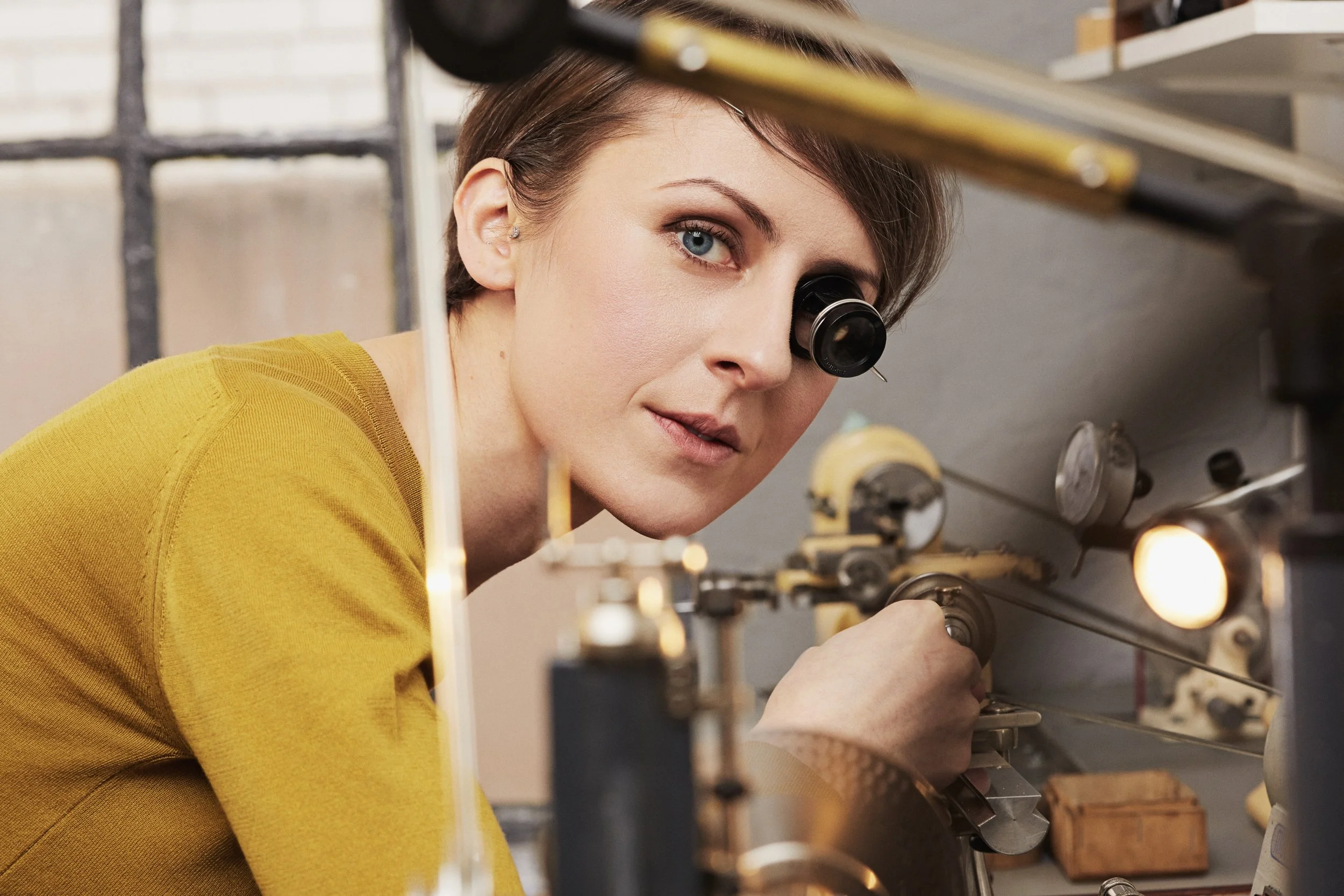
Rebecca Struthers at work on the bench / Credit: Asia Werbel
Andres Ibarguen: How and when did you first get into watches? And what about watchmaking?
Rebecca Struthers: I’d always been aware of watches but it wasn’t until I was 17 that I discovered watchmaking as a career by accident whilst training as a jeweller and silversmith. The university I was studying at happened to teach horology at the same campus. I’ve always had a mutual love for both science and art, discovering watchmaking was the moment I found a way to bring my two passions together. From that point on I knew exactly what I wanted to do with the rest of my life.
AI: What did your journey to become a watchmaker look like?
RS: After I completed two years of jewellery and silversmithing I started the three-year British Horological Institute Course. It’s a brilliant way to gain a good overview of the skills you need to be a watchmaker although, as with any hand skill, you really start to learn once you’re out in the real world. I worked for a few other companies, both as a restorer and as a horological specialist, before my husband Craig and I decided to set up our own workshop in 2012.

Rebecca Struthers / Credit: Andy Pilsbury
AI: As a watchmaker, would you also consider yourself a watch collector or are you more interested in the craft?
RS: We have a few watches, some by well-known brands like Rolex although many are simply weird and wonderful design oddities that caught our attention and have no significant name or value. We have several early 1920s-40s waterproof wristwatches and a few early automatic winding watches. I also have an ample stash of entry-level pieces that are readily available to buy which I like to wear when I’m doing anything media related or public facing. It’s important to me that people discovering watchmaking find it accessible and relatable.
AI: What was it like to earn a doctorate degree in horology? What does it entail exactly?
RS: My PhD took three years to write and the research was a culmination of a project I’d been working on for five years before that. The requirements vary depending on the country you’re studying in. In the UK, for theory-led PhDs, the requirement is an 80,000-word thesis that contributes to knowledge in your field and is examined by established academics at the end of your study. That contribution to knowledge is the most important part - the subject can be almost anything. One of my tutors described knowledge as being an infinite jigsaw puzzle with every thesis filling in a single piece of that puzzle.
AI: You’re also a historian, what kind of history do you specialize in?
RS: My PhD was specifically in the emergence of pre-standardised mass watch production through the examination of a very particular kind of forgery. These are pocket watches made between 1750 and 1820 that are signed as being made in London, however, quite often the watchmaker’s name is fictional and they look very different in style to a genuine London watch. It took me on a journey into how the Swiss industry first started its global domination and the impact more affordable watches, and so, access to time on the move, had on the world around us.
AI: How does your passion for history play into your work as a watchmaker?
RS: As watchmakers Craig and I look back to look forwards. Studying history provides you with such a rich catalogue of designs, both in engineering and aesthetic terms, you can study for inspiration. You get to see what worked, what didn’t, you can cherry pick elements from a global industry that spans over 500 years. Our first in-house movement pays tribute to late 19th century English watchmaking in Coventry, to South German watchmaking of the early 20th century, to Abraham Louis Breguet in 18th century Paris, and to George Daniels in 20th century Isle of Man. I can’t imagine designing and making watches without being a historian too.
AI: How did you and your husband start your watch business? What makes your watches so special?
RS: We decided to start our business after I had a bad run of experiences at work and was struggling with stress. Craig suggested starting our own workshop to get me away from it all and the rest is history! All our watches are hand-built using traditional skills in a process that, so far, has taken between 1 and 6 years for each watch. That means there are very few of them out there. For our in-house movement, where we’re making virtually every component ourselves, the first group being finished this year is of five watches. In the future, we’ll be making one each year so it’s unlikely we’ll make more than 20-30 in our lifetime.
AI: And you have a book coming out soon, please tell us what it’s all about? What was your inspiration for the book?
RS: The inspiration of the book is watches! It’s a history of time told through the objects we’ve invented to measure it, all narrated with the experience and insights of a practising watchmaker. I’ll be taking people inside watches looking for hidden clues about the people that made and wore them, and also, what they can tell us about our constantly evolving relationship with time itself. The book is being published in May 2023.

Credit: Andy Pilsbury
AI: You’ve expressed your interest in heritage engineering before, what other aspects of it are you interested in outside of watchmaking?
RS: Craig and I both love classic cars, scooters, and motorbikes. We have a Series IIA Lightweight Land Rover, a Lambretta, an NSU Prima, and a BSA Bantam at the moment which are more than enough extracurricular projects to keep us busy!
AI: I know you’ve tweeted about it here and there, but what are your thoughts on the recent Moon Swatch release?
RS: I think it’s the work of an absolute PR genius. For two brands owned by the same group to collaborate on an unlimited project which inspired people to queue for days outside boutiques and pay over the odds prices online is a phenomenon we won’t forget for a while!
AI: What about your thoughts on the grey market, as someone who sells their own handcrafted timepieces?
RS: For truly handcrafted watches I don’t see the grey market as a big issue as the reason our clients come to us is because they get to work directly with their watchmaker. I think that’s the case for many independents. For larger brands I can understand the challenge it poses.

The Struthers Watchmakers’ team hard at work / Credit: Andy Pilsbury

Credit: Andy Pilsbury
AI: What is the watch market like in the United Kingdom? And what about the community in Birmingham?
RS: The audience for watches in the UK is very strong, although, the infrastructure for making watches has largely been lost. We used to be world leaders in horology in the 17th and 18th centuries but very little of that is left now. It’s the reason Craig and I started making our own watch cases as we couldn’t find a specialist, we could work with to make small numbers of precious metal cases in the UK. Likewise, it’s hard to get hairsprings, mainsprings, and jewels here. Hopefully the current resurgence will create a market that inspires specialist companies to start making them again, time will tell!
AI: You also recently won the Heritage Crafts President’s Award for Endangered Crafts, what did this achievement mean to you and what do you think the recognition means to the wider watch community?
RS: The award is funding the creation of a free-to-use educational forum for watchmakers we’re building at the moment. Whether you’re established or just starting out, being a watchmaker can be a solitary career so this will be a friendly place where people can come and share what they’re working on, ask for advice, or share their own hints and tips with others. Traditional watchmaking is a critically endangered skill in the UK. We have courses to help people qualify as technicians but very little to support those technicians in building their skills to eventually become masters. Creating a space for people to continue their educational journey after apprenticeship or qualifying as a technician will, I hope, help to bridge that gap.
Thank you, Rebecca, for that insight into your work.